

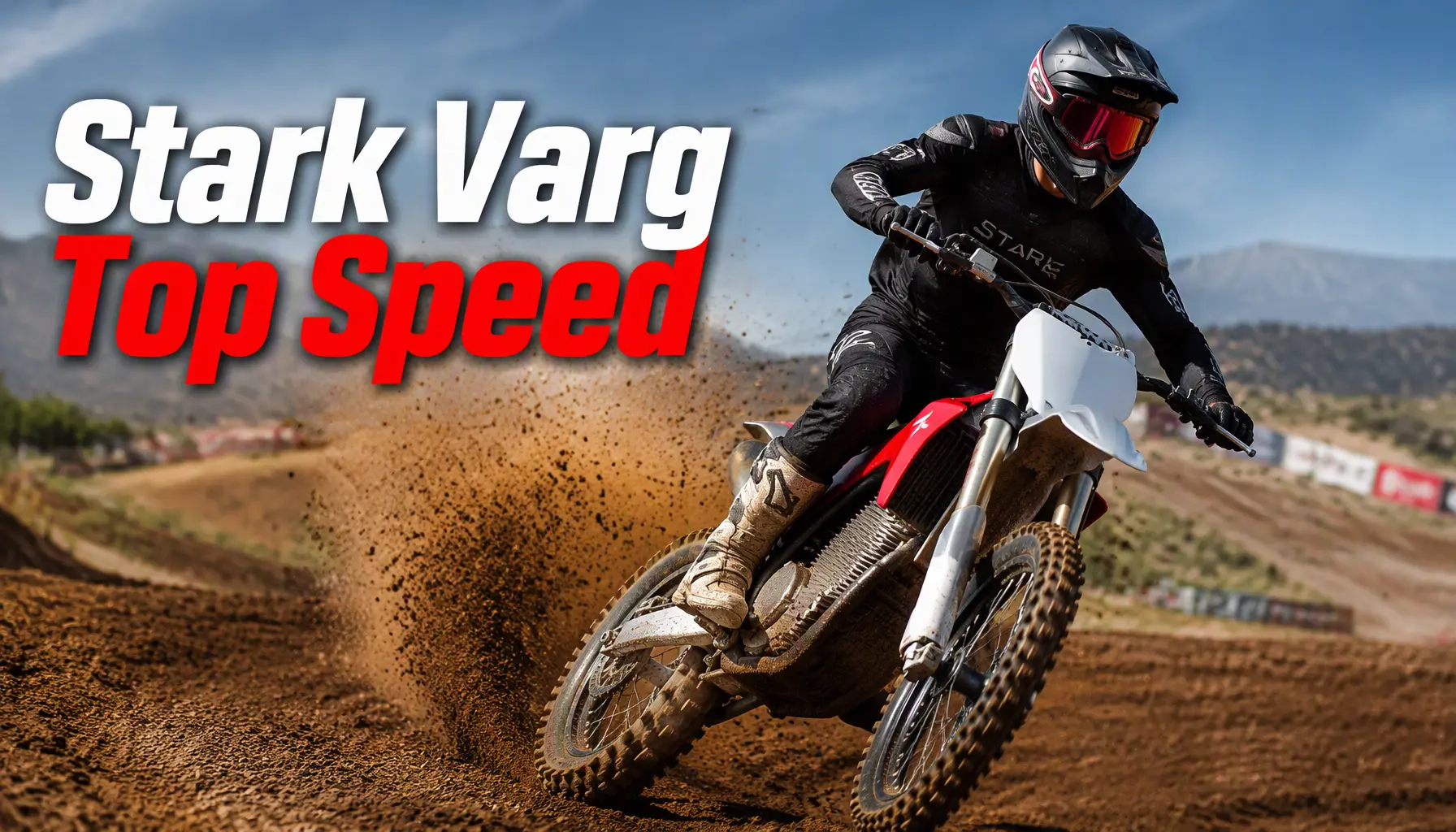
Ever wondered how fast an electric motocross bike can actually go when you stop looking at marketing numbers and look at real testing? The Stark Varg top speed is a surprisingly complicated question because different Varg versions, gearing setups, and test methods can produce very different results.
The Varg is built more like a competition motocross machine than a traditional street motorcycle. It delivers up to 80 horsepower, uses a single-speed electric drivetrain, and puts its power down without clutch shifts or gear changes. Stark’s official documentation also shows that published speed figures can vary between models and configurations.
So, is 70 mph realistic? Can it reach 100 mph? Here’s what the available specifications and real-world testing actually tell us.
What Is the Stark Varg Top Speed?
There isn’t one number that applies to every Stark Varg.
For the current VARG MX 1.2, Stark’s official owner manual lists a top speed of 154 km/h (95.7 mph) for the standard 60-hp specification. However, the manual does not provide the same top-speed figure for the 80-hp Alpha version.
That distinction matters. Many websites simply quote figures such as 65, 80, 100, or even 109 mph without explaining which Varg, gearing setup, or measurement method they’re referring to.
Independent reporting has also recorded higher numbers. SlashGear reported GPS-verified runs of approximately 103–104 mph, while noting that the dashboard speed display is capped at 88 mph.
For that reason, a practical answer is that a Varg can reach roughly 90–100+ mph in suitable configurations, while the exact result depends heavily on gearing and testing conditions.
Why the Varg’s Power Doesn’t Tell the Whole Story
The Varg’s headline power figure gets most of the attention. The 80-hp Alpha powertrain is certainly impressive, but horsepower alone doesn’t determine maximum speed.
The Varg uses a single-speed drivetrain, so final-drive gearing has a major influence on how quickly the bike reaches its maximum motor speed. A shorter setup can emphasize acceleration, while taller gearing can increase potential top speed.
That’s why a motocross bike isn’t necessarily geared like a motorcycle designed for highway speed. Motocross rewards rapid acceleration out of corners, traction, jump control, and predictable power delivery.
Independent testing illustrates this clearly. One detailed Varg test reported approximately 145 km/h (90 mph) with stock gearing and suggested that different sprocket ratios could raise the theoretical top speed substantially.
In other words, more horsepower doesn’t automatically mean a proportionally higher top speed. Gearing, wheel size, tire choice, rider weight, terrain, and available battery power all matter.
How Fast Is the Varg MX 1.2 in Real Riding?
The Varg MX 1.2 is designed primarily for motocross rather than sustained high-speed road riding.
Some dealers list considerably more conservative numbers. For example, one Stark dealer currently lists the MX 1.2 at 65 mph, while another retailer gives a broader 85–109 mph range for its 80-hp Alpha configuration.
That huge difference shows why buyers should ask how a speed figure was measured before comparing bikes.
A dashboard reading isn’t necessarily the same as GPS speed. Tire circumference, gearing changes, wheel spin, and software limits can all affect what the rider sees.
For someone buying the Varg for motocross, I’d focus less on the biggest claimed number and more on how the bike performs between corners. Dirt Rider’s testing highlighted the Varg’s extremely rapid acceleration and strong power delivery compared with conventional 450cc motocross bikes.
That’s where the Varg’s electric drivetrain really makes sense.
Varg Top Speed vs. Varg EX
The Varg EX is a different proposition because it’s the enduro-oriented, road-legal version rather than a closed-course MX bike.
Stark’s official EX owner manual lists a maximum speed of 129 km/h (80.2 mph) for the documented standard configuration.
That figure is useful because it comes directly from Stark’s documentation rather than a retailer or a social-media speed run.
Independent testing of the Varg EX also reported approximately 81 mph (130 km/h). The reviewer noted that changing the sprocket could increase the potential speed, although the EX is primarily intended for off-road capability rather than chasing maximum velocity.
So don’t assume the MX and EX should have identical top-speed figures simply because they share the Varg name and electric powertrain.
What Affects Stark Varg Top Speed?
Several factors can change the speed you actually see.
- Gearing: Taller gearing can increase potential maximum speed, while shorter gearing favors acceleration.
- Power setting: Higher power modes provide more performance headroom, although power mode alone doesn’t guarantee a higher top speed.
- Battery charge: Available battery power can affect performance as the battery becomes depleted.
- Rider weight: A heavier rider requires more energy to accelerate and overcome aerodynamic resistance.
- Terrain: A flat, firm surface produces very different results from sand, mud, or a motocross track.
- Tires and wheels: Different setups change rolling resistance and gearing at the ground.
- Speed measurement: GPS, dashboard readings, and video estimates can disagree.
This is also why two riders can report different Stark Varg top speed figures while both may be accurately describing their own bikes.
Is 100 mph realistic?
Yes, but it shouldn’t be treated as a guaranteed stock speed for every Varg. Independent testing has documented approximately 103–104 mph, while other specifications are substantially lower.
If you’re trying to verify your own bike, GPS measurement on a suitable closed course is much more useful than relying only on the dashboard.
Common Stark Varg Speed Mistakes
One of the biggest mistakes is comparing every Varg as if it’s the same motorcycle.
The original Varg, Varg MX 1.2, Varg EX, and road-focused variants can have different gearing and intended uses. Even within the MX range, published figures can differ between power versions and sellers.
Another mistake is treating an internet video as laboratory testing. A speedometer showing 100 mph doesn’t automatically prove that the motorcycle was traveling at a true 100 mph.
Finally, don’t change gearing simply because you want a bigger speed number. A taller final drive can reduce the punch you feel when accelerating and may not be useful on a technical motocross track.
The fastest setup on paper isn’t necessarily the fastest setup around a real track.
Stark Varg Top Speed: Quick FAQs
What is the official Stark Varg top speed?
For the VARG MX 1.2, Stark’s official manual lists 154 km/h (95.7 mph) for the standard 60-hp specification. The 80-hp Alpha version does not receive the same top-speed figure in that manual.
Can a Stark Varg reach 100 mph?
Some independent tests have recorded approximately 103–104 mph using GPS, but that shouldn’t be interpreted as a guaranteed speed for every stock Varg. Gearing and test conditions make a major difference.
What is the Varg EX top speed?
Stark’s Varg EX owner manual lists 129 km/h (80.2 mph) for the documented configuration. Independent testing has produced a very similar figure of about 81 mph.
Does the 80-hp Varg have a higher top speed?
Not necessarily by a simple one-to-one relationship. The 80-hp version has more power available, but gearing and the motor’s speed limit also determine maximum velocity.
Does gearing affect Varg top speed?
Yes. Final-drive gearing can change the balance between acceleration and maximum speed. Taller gearing can increase potential top speed, while shorter gearing generally favors stronger acceleration.
Is the Stark Varg faster than a 450cc dirt bike?
Top speed alone doesn’t provide a complete comparison. The Varg’s major advantage is its immediate electric power delivery and acceleration. Dirt Rider testing found its acceleration characteristics particularly impressive compared with conventional 450cc motocross bikes.
Conclusion
The Stark Varg top speed depends on which Varg you’re talking about and how the bike is configured.
- VARG MX 1.2: Stark’s manual lists 95.7 mph for the documented 60-hp specification.
- Independent testing: Some Vargs have recorded around 103–104 mph by GPS.
- VARG EX: Official documentation lists 80.2 mph.
- Gearing: One of the biggest factors affecting maximum speed.
- Real-world performance: Acceleration and power delivery can matter more than the final number on the speedometer.
If you’re shopping for a Varg, check the exact model, power version, gearing, and intended use before comparing top-speed claims. That will give you a much more realistic idea of what the bike can do.