

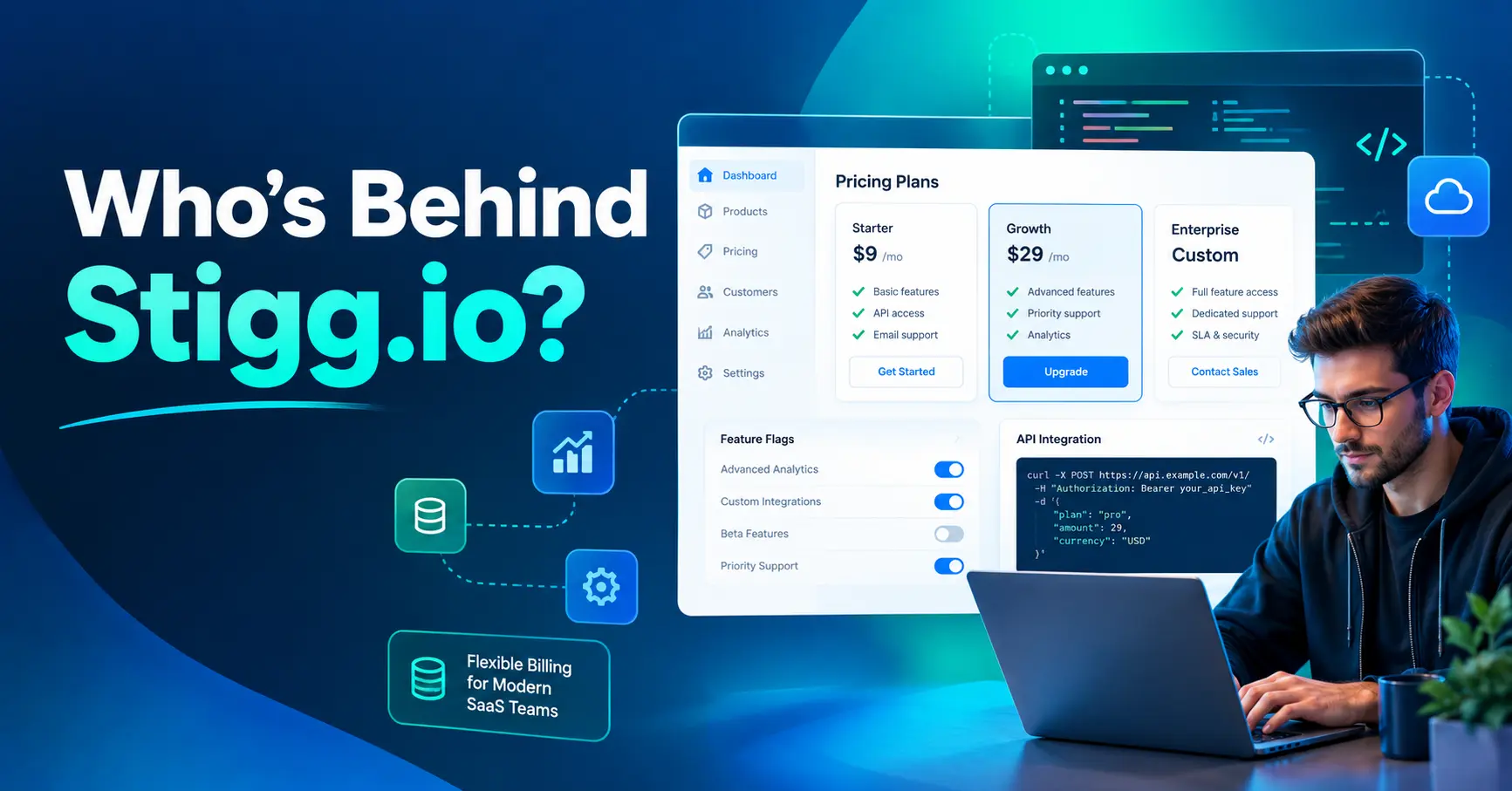
If you’ve come across Stigg.io while researching monetization tools for SaaS products, you might be wondering exactly who’s behind it. The company operating the platform is called Stigg Inc., a startup headquartered in Tel Aviv, Israel. Stigg was built to help software companies manage pricing, packaging, and billing without draining engineering resources on every single change. Instead of hardcoding pricing logic into a product, teams use Stigg’s APIs to control what gets priced, packaged, and unlocked for each customer. The company has grown quickly, attracting enterprise customers and real outside investment along the way. Below, I’ll walk through who actually runs Stigg and why this name keeps coming up in SaaS pricing conversations.
The Company Behind Stigg.io
Stigg Inc. is the legal entity behind the Stigg.io platform, registered and based in Tel Aviv, Israel. It’s a private, for-profit company operating in the developer tools and infrastructure space, with a small team of roughly eleven to fifty employees. Stigg positions itself as a unified monetization platform, centralizing pricing, packaging, entitlements, and subscription management in one system. Its official contact address, info@stigg.io, reflects that branding across the website, product, and communications. Despite the fairly compact team size, Stigg has built a solid reputation among engineering-led SaaS companies looking for infrastructure that removes billing complexity from their codebase entirely.
Meet the Founders
Stigg was co-founded by Dor Sasson, who serves as Chief Executive Officer, and Anton Zagrebelny, who holds the Chief Technology Officer role. Sasson previously worked as Head of Product at Thumzap before starting Stigg, bringing product experience into the founding vision. Together, the two set out to solve a problem they’d likely seen firsthand: engineering teams burning weeks rebuilding pricing logic every time a company wanted to test a new plan. Their combined leadership has steered Stigg from an early-stage startup toward a company trusted by recognizable SaaS brands, while keeping the platform focused on developers and product teams.
What Stigg.io Actually Builds
At its core, Stigg is a headless pricing and packaging platform designed for engineers. Rather than shipping a rigid billing dashboard, it exposes APIs and SDKs that let developers define plans, entitlements, and usage rules directly in code. This means product teams can launch a new pricing tier or adjust feature access without waiting on a lengthy development cycle. The platform also connects to existing billing providers and CRMs, so companies don’t need to rip out their current financial stack. For teams shipping AI features or usage-based products, that flexibility has become increasingly valuable as pricing grows more complex.
Core Features That Set Stigg Apart
Stigg’s standout capability is combining advanced metering with entitlements in a single system, something the company markets as true hybrid pricing. Metering tracks real-time feature and API usage, while entitlements control exactly what each customer can access based on their plan. This pairing lets a business charge a flat subscription fee, add usage-based overages, and gate premium features from one configuration layer. Stigg has also introduced tools for AI credit models, letting companies launch consumption-based pricing for AI products without a full billing migration. These features target a real gap left by legacy billing tools built before AI-era pricing.
Stigg vs. Traditional Billing Approaches
Here’s a quick side-by-side look at how Stigg’s approach differs from older, manually built billing setups many SaaS companies still rely on today. Older setups usually grew organically, with each pricing idea bolted onto whatever billing code already existed, which slowly made changes riskier to ship. Stigg replaces that patchwork with a single configuration layer that engineering, product, and go-to-market teams can all read from, mattering most once a company scales past its first pricing plans.
| Aspect | Traditional Billing Setup | Stigg.io Platform |
|---|---|---|
| Pricing changes | Require engineering sprints | Configured via API/no-code |
| Entitlements | Often hardcoded per feature | Centralized and dynamic |
| Usage metering | Custom-built internally | Built-in, real-time tracking |
| AI/credit pricing | Requires new infrastructure | Native credits suite |
| Integration | Standalone system | Layers on existing billing tools |
The table shows why engineering teams increasingly treat monetization as its own dedicated layer rather than an afterthought bolted onto the product.
Who Relies on Stigg.io
Stigg counts recognizable names among its customer base, including Miro, Webflow, and PagerDuty, all companies operating complex, fast-moving SaaS products. These customers typically share a common need: running pricing experiments frequently without pulling engineers off feature work every time. Growth and product teams use Stigg’s no-code layer to test packaging ideas, extend trials, or grant VIP feature access to specific accounts. Sales teams benefit too, since deals closed in Salesforce can be migrated into new pricing configurations quickly. That mix of technical depth and business flexibility is a reason mid-market and enterprise SaaS companies keep choosing the platform.
Funding and Company Growth
Stigg announced a $17.5 million Series A funding round in December 2024, a signal of strong investor confidence in the monetization infrastructure space. The company said the capital would fuel global expansion and help build out its go-to-market organization, with a specific focus on growing its presence in New York. This followed an earlier seed round that helped the founders build the initial product and land early design partners. As AI-native software companies search for pricing models suited to usage-based consumption, Stigg’s timing has positioned it well within a category attracting growing attention from customers and venture investors alike.
How Stigg.io Fits Into the Monetization Stack
Stigg offers tiered plans built around how much a company enforces through the platform rather than seat count, starting with a free Build tier for smaller teams. The Pro tier introduces pay-as-you-grow pricing for scaling companies, while the Scale tier offers custom contracts, dedicated support, and bring-your-own-cloud deployment. Each tier includes a platform SLA, with higher tiers adding named customer success managers and migration assistance. Because Stigg integrates with existing CRMs and billing providers instead of replacing them outright entirely, companies can adopt it gradually and carefully, layering entitlements and metering onto infrastructure they already have in place.
Conclusion
So, to answer the original question directly: the company behind Stigg.io is Stigg Inc., founded by Dor Sasson and Anton Zagrebelny out of Tel Aviv, Israel. It has grown into a monetization platform used by companies like Miro, Webflow, and PagerDuty, backed by a $17.5 million Series A round. Its core strength lies in combining entitlements, metering, and hybrid pricing into one API-driven system built for engineers. Whether you’re evaluating it as a potential vendor or just curious about the name, Stigg.io represents a growing category of infrastructure built to make SaaS pricing changes fast and far less painful.