

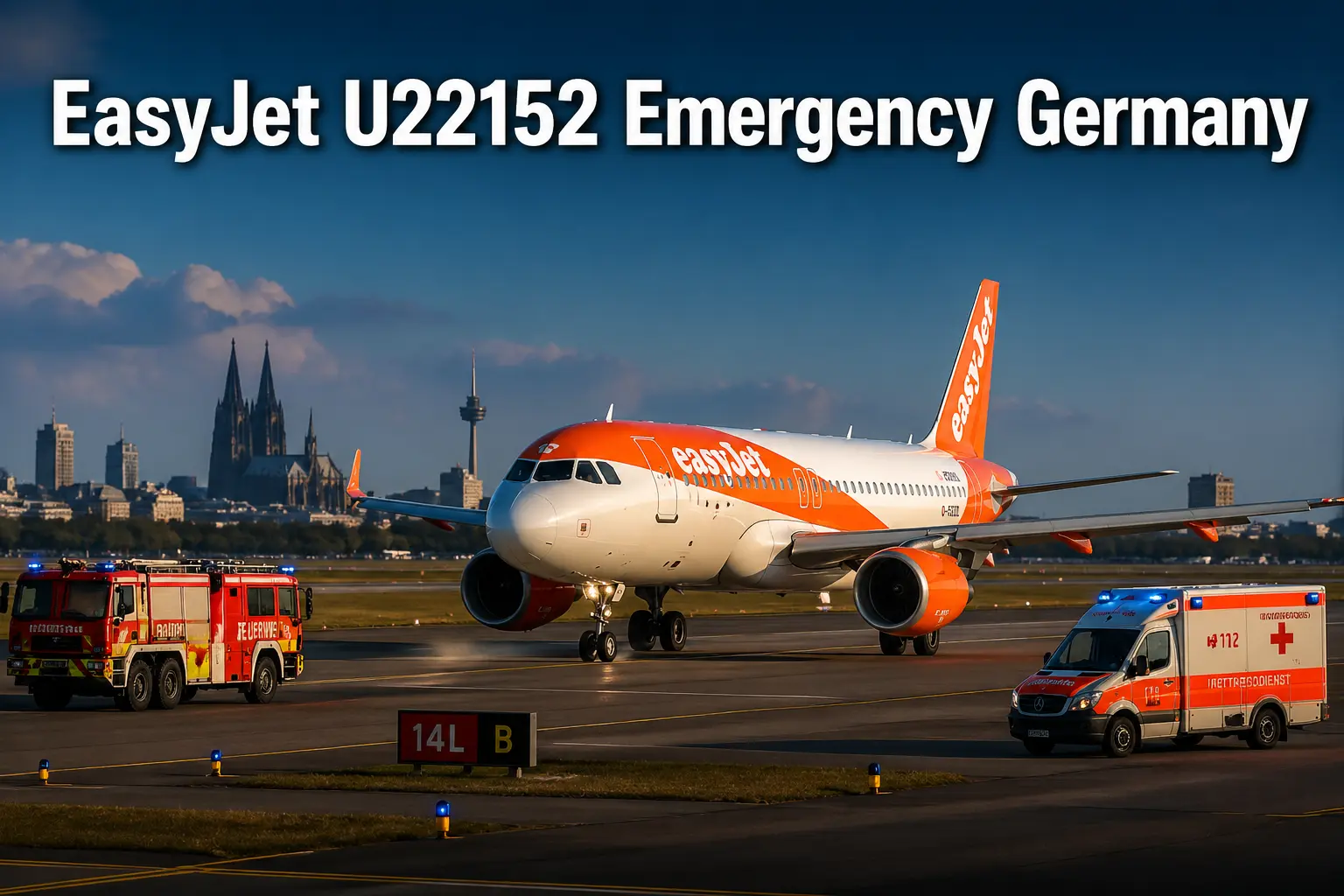
You’re sitting on a flight, the seatbelt sign has been off for an hour, and suddenly it clicks back on without warning. The cabin crew stop their service mid-aisle, speak quietly to each other, and moments later the captain’s voice comes over the intercom. That is almost exactly what 185 passengers experienced on August 15, 2025, when EasyJet U22152 declared an emergency over Germany and changed course toward Cologne.
The EasyJet U22152 emergency Germany incident became one of the most talked-about aviation stories in the UK that summer, and for good reason — it raised real questions about what happens when a pilot becomes incapacitated mid-flight and how the aviation system is designed to cope. This article walks through everything that happened that day, from the moment the first officer collapsed in the cockpit to the safe touchdown at Cologne Bonn Airport, and explains what it all means for anyone who regularly flies with budget carriers across Europe.
What Was Flight U22152 and Where Was It Going?
EasyJet U22152 is a scheduled service that operates between Istanbul Airport in Turkey and Manchester Airport in the United Kingdom. The route covers roughly 1,650 miles and takes around four to four and a half hours on a standard Airbus A320. It is part of easyJet’s network connecting Turkey with northern European destinations, and on most days it departs Istanbul in the early afternoon and arrives in Manchester by early evening.
On August 15, 2025, the aircraft assigned to the route was an Airbus A320-200 registered as G-EZRX. It pushed back from Istanbul on time with no reported technical issues. There were 185 people on board, and the flight climbed normally to its cruise altitude of 36,000 feet — known in aviation as flight level 360 — before settling into the usual crossing over southeastern Europe. For the first two hours of the flight, nothing was out of the ordinary. The seatbelt signs went off, the crew served refreshments, and passengers settled in for what should have been a routine afternoon service to Manchester.
The Moment Everything Changed Over Germany
Approximately two hours into the cruise, while the aircraft was flying over southern Poland and approaching German airspace, the first officer collapsed. He had developed severe stomach pain — suspected food poisoning, though no confirmed diagnosis was ever made public. For the passengers in the cabin, the first sign that something was wrong was the seatbelt sign illuminating again without any turbulence to explain it.
At 15:41 UTC, the aircraft broadcast squawk 7700 — the internationally recognised emergency transponder code that tells air traffic controllers and ground tracking systems that a flight is facing a serious situation requiring immediate priority. Aviation tracking platform Airlive.net detected the signal, and within minutes reports began circulating online about a possible emergency over German airspace. The aircraft, which had initially been flagged as possibly having a pressurisation issue, was in fact responding to a crew medical emergency — the first officer was no longer able to perform his duties.
The captain was unaffected and remained fully in control of the aircraft throughout. His next decision was critical: which airport to head for, and how quickly to get there.
Why the Captain Chose Cologne
With one pilot down and 185 passengers on board, the captain needed to land as soon as possible at the most suitable airport within reach. Cologne Bonn Airport was the answer. At the time of the emergency, the aircraft was roughly 150 nautical miles east-southeast of Cologne — close enough to reach quickly and equipped with everything needed to handle an Airbus A320 emergency arrival.
Germany’s position at the heart of European airspace makes it one of the most practical places on the continent for unplanned diversions. Cologne Bonn Airport specifically offers long runways, full emergency response capability, and direct links to the University Hospital of Cologne, one of Germany’s leading medical centres. For a captain who needed to get a sick crew member into medical care as fast as possible while also minimising the time he spent flying solo, Cologne was the logical choice.
German air traffic control cleared the path immediately. Adjacent traffic was moved aside, a direct routing to Cologne was allocated, and ground emergency teams were alerted and positioned. The aircraft descended and turned west, and the captain kept his passengers informed with several calm announcements explaining the diversion.
The Landing and What Happened on the Ground
Flight U22152 touched down safely on runway 14L at Cologne Bonn Airport at 16:42 local time — just over an hour after the emergency was declared. Fire and rescue vehicles followed the aircraft as it taxied to a remote stand, which allowed an ambulance direct access without the delays of a busy terminal gate. The Airbus taxied under its own power and both engines shut down normally, confirming there was no mechanical problem with the aircraft itself.
Within four minutes of the aircraft stopping, a medical team from the Cologne Fire Department and two emergency physicians were on board. The first officer had been moved to the forward galley — easier to access and closer to the door. He was stabilised on board for around twelve minutes before being transferred on a stretcher to a waiting intensive-care ambulance, which transported him to the University Hospital of Cologne.
Passengers described the atmosphere on board as tense but remarkably calm. The remaining cabin crew continued to reassure travellers, served water, and kept communication clear throughout the process. Several passengers posted real-time updates on social media during and after the landing, with the hashtag #U22152 trending briefly in the UK and Germany that evening.
By August 18, 2025, easyJet confirmed that the affected crew member had been discharged from hospital and was recovering well at home.
How the Aviation System Is Built for Exactly This Situation
The EasyJet U22152 emergency Germany incident is not just a news story — it is a textbook example of layered aviation safety working exactly as designed. Commercial aviation requires at least two qualified pilots on every flight for a reason. When one becomes incapacitated, the other is trained to manage the aircraft alone, declare an emergency, and execute a diversion without losing control of the situation.
Pilots operating on European routes eat different meals specifically to reduce the risk of both crew members being affected by food-related illness at the same time. On flight U22152, only the first officer was taken ill, which means the meal separation rule — if it was followed — produced precisely the outcome it was designed to produce. The captain remained healthy and in full command.
Beyond the dual-pilot system, the Squawk 7700 emergency code is part of a broader communication network that instantly alerts air traffic controllers, ground services, and tracking systems. It does not mean the aircraft is in danger of crashing — it means the crew has identified a situation that requires priority handling. On this flight, that handling was flawless. Air traffic control cleared the route, emergency teams were ready on the ground, and the aircraft landed in under 30 minutes from the point of declaration.
Pilots also undergo rigorous and regular medical screening under aviation authority supervision. Sudden illness, however, can occur despite clean medical records, which is exactly why diversion procedures exist and are practised repeatedly during training. The system accounts for human unpredictability.
What Passengers Were Entitled to After the Delay
Because the diversion extended the total delay to Manchester beyond four hours, passengers on U22152 were entitled to compensation under EU/UK regulation 261/2004. The fixed amount for a delay of this length on a flight of this distance is €400 per passenger. EasyJet proactively contacted affected travellers and processed most claims automatically rather than requiring passengers to file individually.
The aircraft itself continued to Manchester later that evening after a replacement crew member was arranged. Passengers arrived several hours behind schedule but safely, and the Airbus A320 returned to normal service on the route shortly afterward.
It is worth noting that not all medical diversions qualify for compensation. European passenger regulations treat genuine medical emergencies differently from delays caused by airline-controlled factors. In this particular case, however, the compensation applied because the disruption extended beyond the threshold despite the emergency classification.
What the EasyJet U22152 Emergency Germany Means for Travellers
If you are someone who flies regularly — particularly with budget carriers on European routes — the EasyJet U22152 emergency Germany incident is actually reassuring once you understand what happened. A pilot became seriously ill at 36,000 feet, and within 30 minutes the aircraft was safely on the ground with medical professionals on board. Nobody was hurt except the crew member who was already ill, and even he was discharged from hospital within three days.
That outcome did not happen by chance. It happened because of years of procedure development, crew training, international coordination between air traffic control systems, and well-resourced airport emergency teams. Every single layer of the safety system activated correctly and on time.
EasyJet holds a 7/7 safety rating from AirlineRatings.com and was ranked the second safest low-cost airline in the world in 2024. That rating reflects a culture of early action and precaution over schedule — exactly what the captain demonstrated by declaring an emergency the moment his first officer became incapacitated rather than waiting to see if the situation would resolve itself.
Medical emergencies occur on approximately one in every 600 commercial flights worldwide. The majority involve passengers rather than crew, but incidents involving pilots are handled with additional urgency because of their potential impact on flight operations. Diversions for medical reasons have an outstanding safety record globally, with virtually no accidents directly linked to the diversion itself.
Conclusion
The EasyJet U22152 emergency Germany incident on August 15, 2025, began with a first officer collapsing in the cockpit over German airspace and ended with a safe landing at Cologne Bonn Airport, a swift medical response, and 185 passengers eventually continuing their journey to Manchester.
The captain’s rapid decision to declare an emergency and divert, the seamless coordination with German air traffic control, and the professional conduct of the cabin crew throughout the event reflect everything that modern commercial aviation is built to do.
Far from being a sign that flying is dangerous, the EasyJet U22152 emergency Germany story is evidence that the systems in place work — even in the most unexpected circumstances. The next time you board a flight and see emergency vehicles standing by at a distant airport, understand that you are looking at preparedness, not crisis.
Frequently Asked Questions
What happened on EasyJet flight U22152?
EasyJet flight U22152 from Istanbul to Manchester declared an emergency on August 15, 2025, after the first officer collapsed in the cockpit with severe stomach pain suspected to be food poisoning. The captain diverted the aircraft to Cologne Bonn Airport, where it landed safely with 185 people on board.
Was the EasyJet U22152 emergency Germany incident a crash?
No. The aircraft landed safely under full control. There was no crash, no structural damage, and no injuries caused by the flight itself. The only person requiring medical attention was the first officer who had become ill.
Why did EasyJet U22152 divert to Cologne specifically?
Cologne was the closest suitable airport to the aircraft’s position at the time of the emergency. It has long runways, full emergency services, and proximity to the University Hospital of Cologne, making it the fastest option for getting the sick crew member into medical care.
Were passengers on U22152 entitled to compensation?
Yes. Because the delay to Manchester exceeded four hours, passengers were entitled to €400 each under EU/UK regulation 261/2004. EasyJet processed most of these claims automatically and contacted affected travellers directly.
How long did the EasyJet U22152 emergency Germany diversion take?
From the time the emergency was declared at 15:41 UTC, the aircraft was on the ground at Cologne within approximately 30 minutes. Emergency medics were on board within four minutes of the aircraft stopping.
Did the first officer recover after the EasyJet U22152 emergency Germany incident?
Yes. By August 18, 2025, easyJet confirmed that the crew member had been discharged from hospital and was recovering well at home.
Is this type of pilot incapacitation common in aviation?
Pilot incapacitation is rare but accounted for in aviation safety design. Historical data shows that stomach illness is the single largest category across recorded pilot incapacitation cases, which is one reason airlines use meal separation protocols to ensure not both pilots eat the same food at the same time.
Category: News