

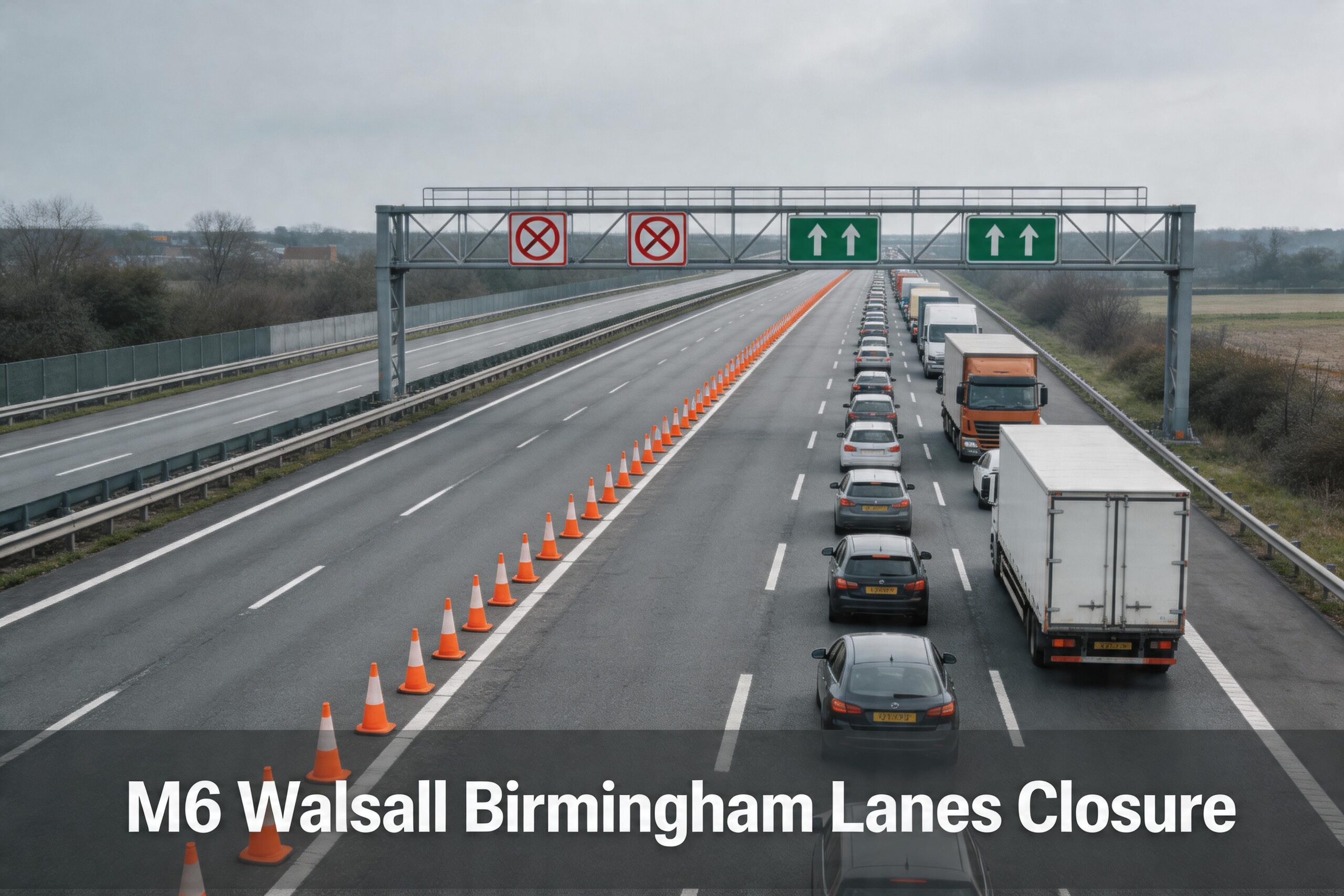
You’re running on time, the coffee is warm, and then suddenly everything stops. The motorway ahead turns into a car park and your sat-nav starts giving you routes you’ve never heard of. If you’ve driven between Walsall and Birmingham recently, you already know this feeling. The M6 Walsall Birmingham lanes closure has become one of the most talked-about traffic issues across the West Midlands in 2026, and for very good reason.
This stretch of road carries an enormous number of vehicles every single day, and when even one lane disappears, the knock-on effect spreads across miles of motorway and dozens of connecting routes. This article covers exactly what is happening, why it keeps happening, and what you can actually do about it before you leave the house.
What the M6 Walsall Birmingham Lanes Closure Actually Involves
When people talk about the M6 Walsall Birmingham lanes closure, they are usually referring to a section of the M6 motorway that runs between junction 10 near Walsall and junction 6 near Birmingham’s infamous Spaghetti Junction. This corridor is roughly 10 miles of motorway that acts as a vital artery for the entire West Midlands region. It is not just a road that local drivers use. It connects freight traffic coming from the north, commuters heading into central Birmingham, vehicles linking to the M5 and M42, and long-distance travelers passing through the middle of England.
The closures themselves can be either planned or unplanned. Planned closures tend to involve overnight maintenance windows, typically running from around 9pm to 6am on weeknights, during which National Highways teams carry out work like resurfacing, bridge joint replacement, barrier repairs, and gantry installation. Unplanned closures happen when accidents, breakdowns, or spillages force emergency services to close lanes without warning. Both types are happening with noticeable regularity in this area throughout 2026, which is why drivers need to treat this route differently than they might have done a year or two ago.
The key junctions that keep appearing in traffic reports are junction 10 near Walsall, junction 7 at Great Barr, and junction 6 near the Birmingham interchange. Junction 9 near Wednesbury also features regularly in update bulletins. Each of these points matters because they are where traffic joins or leaves the motorway, and when lane space is reduced, those joining and leaving movements become much more difficult and slow.
Why This Part of the M6 Is So Sensitive to Disruption
Not all motorway closures cause the same amount of chaos. A lane closure on a quiet rural stretch is a completely different experience to a lane closure between Walsall and Birmingham. The reason this particular section causes such significant problems comes down to volume, density, and the sheer complexity of the road network in this part of the country.
The West Midlands is one of the most densely populated regions outside of London. Birmingham itself is the UK’s second largest city, and Walsall sits at the top of the metropolitan area as a busy industrial and commercial centre. The M6 corridor between them handles a constant flow that includes commuter cars, delivery vans, lorries carrying goods to distribution centres, construction vehicles, buses, and vehicles heading to and from Birmingham Airport via connecting routes. When you squeeze all of that traffic through a reduced number of lanes, the mathematics become very unkind very quickly.
There is also the issue of driver behaviour. On roads where people use the same route every single day, even small changes to the normal pattern create hesitation. Drivers slow down when they approach unfamiliar lane restrictions, merge later than they should, and sometimes make sudden decisions that cause braking waves to ripple back through traffic. A two-lane closure near junction 7, for example, can back traffic up well past junction 8 where the M5 interchange sits, spreading the problem onto an entirely different motorway.
The smart motorway technology installed on parts of this route does help to manage traffic, with overhead gantries able to close lanes instantly, lower speed limits, and direct drivers in real time. But even that system cannot conjure extra road space that simply does not exist when volume is high and multiple lanes are out of action.
The 2026 Maintenance Schedule and What It Means for You
The closures happening right now are not random. National Highways has a structured programme of maintenance and improvement works affecting the M6 between Walsall and Birmingham throughout 2026. Understanding the rough shape of that schedule helps drivers plan better and feel less surprised when they encounter cones on a Tuesday night.
Earlier in the year, bridge maintenance work was carried out near junctions 5 and 6 during overnight windows. Through March 2026, there were temporary full carriageway closures affecting the southbound direction between junctions 6 and 4, running on weeknights from 9pm to 6am. Emergency barrier repairs in late March led to two lanes being closed in both directions between junctions 7 and 6, with delays of around 30 minutes being reported for drivers on approach. From 7 April 2026, a fresh phase of work began on the northbound stretch near junctions 5 and 6, involving a combination of lane closures, slip road closures, and full overnight carriageway closures at certain points. The southbound phase of the same work is expected to follow on from the northbound work, extending the disruption period further into spring.
There are also separate works connected to the wider M6 improvement scheme affecting junction 10 in Walsall, which has been a long-running improvement programme linked to upgrading that junction and managing the connecting link to the M54. Walsall Council has acknowledged this work in its own published road update documents. On top of the scheduled National Highways works, the smart motorway gantry construction programme has added further lane restrictions at specific points between junctions 10 and 11 on the northbound side. The picture, in short, is that April and May 2026 represent one of the more disrupted periods this route has seen in recent years, and drivers should treat it that way.
How Delays Actually Build Up on This Route
Here is something that catches a lot of drivers off guard. You might check traffic before leaving and see that everything looks green, then find yourself sitting in a queue 20 minutes later. That happens because delay on this route builds quickly and non-linearly. The problem is not always at the closure itself. It is at the approach to the closure, where multiple lanes feed into fewer lanes and everyone has to slow down.
A lorry that takes a little longer to merge because it cannot accelerate quickly will cause the car behind it to brake, which causes the car behind that to brake harder, and within 30 seconds you have a slowdown rippling back half a mile. Multiply that across hundreds of vehicles approaching junction 7 from the north, or approaching junction 6 from the south, and the queue forms faster than it can clear. Traffic engineers call this a shockwave, and this part of the M6 is particularly prone to them because of the volume and the mix of vehicle types.
Evening rush hour between about 4:30pm and 7pm is consistently the worst window, even when the planned overnight closures have not started yet. That is because daytime traffic volume means any residual congestion from the night before has not fully cleared, and afternoon commuter traffic adds to a road that is already operating close to capacity. The period between roughly 8pm and midnight is when many planned closures begin, which creates a short but very busy transition window where evening drivers are still finishing their journeys and overnight crew setup is beginning.
Smarter Alternatives When the M6 Is Restricted
The temptation when you see a motorway closure is to immediately jump onto local roads. The A34 Birmingham Road is one of the most common diversions people choose when the M6 between Walsall and Birmingham is disrupted, and it can work reasonably well if you are one of the first drivers to make that choice. The problem is that sat-nav systems across thousands of vehicles will suggest similar routes at the same time, which means local roads in Walsall, Great Barr, and north Birmingham can fill up very quickly once a significant closure is reported.
A more thoughtful approach involves looking at whether the M6 Toll is a viable option for your specific journey. The Toll road runs parallel to the M6 through the Birmingham area and can bypass the worst of the congestion near junctions 6 and 7. It does cost money and it is not a free solution, but during a significant planned closure when you know your journey is important, it is often worth the fee to avoid an unpredictable delay on the main carriageway. The M5 to the west and the M42 to the east also provide wider bypass options for drivers whose destination allows for a longer but potentially faster route around the affected area.
If you are a regular user of this route, the most valuable thing you can do is learn two or three alternative roads properly before you need them. Trying to navigate unfamiliar streets while already stressed in heavy traffic is not a pleasant experience. Knowing in advance that you can take a specific road through Great Barr and rejoin the motorway further south gives you a real option rather than just following whatever your phone tells you in the moment.
The Wider Impact on the West Midlands Region
The M6 Walsall Birmingham lanes closure is not just a problem for car drivers. The economic and logistical impact on the wider region is significant and often underappreciated by people who do not work in freight, distribution, or time-sensitive services. Delivery companies that operate routes through the West Midlands build their schedules around expected transit times. When those times stretch by 30 or 60 minutes on a regular basis, it affects arrival windows, customer promises, and driver working hours all at once.
The same applies to service engineers, healthcare workers, tradespeople, and others who travel between multiple sites during a working day. A traffic delay that costs 45 minutes on the M6 can turn a manageable schedule into an impossible one. Smaller businesses in particular often cannot absorb that kind of disruption without it affecting their work and their relationships with customers.
There is also a public transport dimension. Bus services that use motorway-adjacent roads can be disrupted by M6 congestion even when they are not on the motorway itself. If feeder roads in Walsall and Great Barr fill up with diverted motorway traffic, buses slow down and services become unreliable for passengers who depend on them. It is one of those ripple effects that does not make the news but affects a large number of people in a very real way every day.
What to Do Before Every Trip on This Route
The single most effective thing any driver can do is spend two minutes checking traffic before leaving. That sounds obvious, but a surprising number of people assume conditions will be similar to yesterday and do not check until they are already stuck in a queue. Traffic England and National Highways both provide live updates, and apps that show real-time congestion can give a much more accurate picture of current conditions than a quick glance at a traffic update from three hours ago.
When you do check, pay attention to direction. Northbound and southbound conditions on this section of the M6 can be completely different. A full overnight closure in one direction may not affect the other at all, so knowing which way you are travelling and what that specific direction looks like is essential. It is also worth noting whether any reported closure is planned or incident-related, because incident-related closures tend to clear faster but are harder to predict, while planned closures have a reliable end time that you can build your journey around.
Leaving a buffer of 20 to 30 minutes on top of your normal expected travel time is a reasonable habit to build in right now. It will not feel necessary on most days, but on the days when it is needed, it will be the difference between arriving on time and arriving stressed and late.
Staying Safe While Driving Through the Work Zones
One final point that does not get enough attention is how driver behaviour inside work zones affects everyone’s safety and journey time. When lanes are restricted and cones are present, the temptation to push into a closing lane at the last possible moment is strong. But late lane mergers slow traffic for everyone behind them and increase the risk of minor collisions in a zone where construction workers may be present nearby.
The better approach is to move into the correct lane as soon as the signs indicate a restriction ahead. This creates a smoother flow and actually gets drivers through the closure faster than aggressive late merging does. Speed limits through active work zones on this route are strictly enforced with average speed cameras, so maintaining the posted limit is not just a legal obligation but also a consistent way to travel safely through the affected section.
Conclusion
The M6 Walsall Birmingham lanes closure is one of those situations that rewards preparation and punishes assumption. This route matters deeply to the daily lives of thousands of people across the West Midlands, and the current period of maintenance and improvement work means conditions are going to keep changing through spring and into early summer 2026.
Knowing which junctions are most affected, understanding how delays build up on this road, and having a realistic alternative in your head before you set off are the three things that will make the biggest difference to your experience. Check traffic before you leave, allow extra time, and stay patient through the work zones. The road is being improved for the long term, and a little extra planning right now will save a lot of unnecessary stress.
Frequently Asked Questions
What is the M6 Walsall Birmingham lanes closure?
It refers to lane restrictions or full overnight closures on the M6 motorway between Walsall and Birmingham, caused by ongoing maintenance, bridge work, barrier repairs, or road incidents. These closures have been particularly frequent throughout 2026 as National Highways carries out a structured programme of improvements on this corridor.
Which junctions are most affected by the closure?
Junction 10 near Walsall, junction 7 at Great Barr, and junction 6 near Birmingham’s Spaghetti Junction area are the most consistently mentioned points. Junction 9 near Wednesbury also appears regularly in traffic reports when related maintenance work is active nearby.
Does the M6 Walsall Birmingham lanes closure affect both directions?
Not always at the same time. Northbound and southbound works are often carried out in separate phases, which means conditions in one direction can be very different from the other. Checking your specific direction before travelling is important.
When are delays typically worst on this stretch?
Evening rush hour between 4:30pm and 7pm is consistently the most congested period. Overnight closures usually begin around 9pm and run until 6am, making late evening and very early morning travel higher risk for significant disruption.
Is there a good alternative to the M6 during closures?
The M6 Toll provides a parallel option through the Birmingham area and can bypass the worst congestion near junctions 6 and 7. The A34 Birmingham Road works for shorter diversions but fills up quickly when many drivers choose it at the same time. The M5 and M42 serve as wider detours for those with flexible routes.
How long are the planned closures expected to continue?
Based on the published maintenance schedule, drivers should expect disruption through April and into May 2026 at minimum. Multiple work phases are planned across different sections and directions, so even when one phase ends, another may follow on a nearby stretch.
Why does traffic on this road back up so far from the actual closure?
The high volume of vehicles combined with the mix of cars and large lorries creates shockwave-style congestion where each vehicle braking causes the one behind it to brake harder. On a busy motorway this effect can push queues back several miles from the actual closure point within a short space of time.