

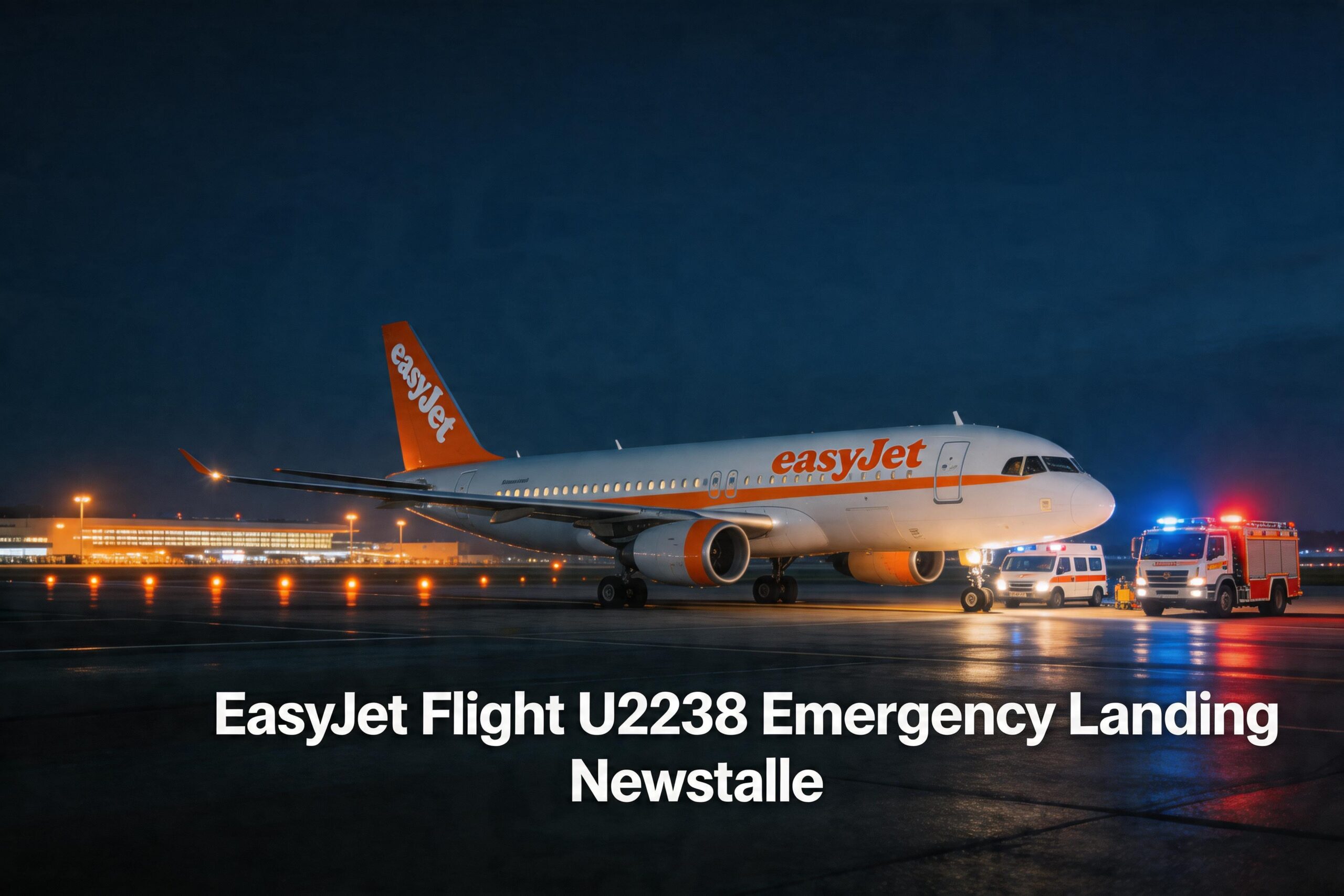
Imagine you’re settled into your seat, headphones on, half asleep somewhere over the North Sea, expecting to land in Manchester in about an hour. Then the engines change pitch, the cabin crew moves quickly, and the captain’s voice comes over the intercom saying you’ll be landing somewhere different tonight. That’s exactly what happened to passengers aboard EasyJet Flight U2238 on the night of 27 October 2025. The EasyJet Flight U2238 emergency landing Newcastle became one of those incidents that reminds the world just how seriously aviation takes human life — and how prepared professionals are when things go wrong at cruising altitude.
This isn’t a story about a crash or a near-disaster caused by mechanical failure. It’s actually a story about things going right. About a crew making the correct call under pressure, air traffic controllers clearing a path within seconds, and paramedics waiting at the runway before the wheels even touched the ground. Understanding what happened that night tells you a great deal about how commercial aviation actually works when a passenger’s life is on the line.
What Exactly Was EasyJet Flight U2238 and Where Was It Going?
EasyJet Flight U2238 — also recorded in aviation systems as EZY2238 — was a scheduled service operating from Copenhagen Airport in Denmark to Manchester Airport in the United Kingdom. The aircraft was an Airbus A320-214, registered as G-EZPB, powered by CFM56-5B4/P engines and fitted with the distinctive Sharklet winglets you’d recognise on modern short-haul jets. It had been in continuous service with easyJet since February 2016 and had no reported technical issues whatsoever on that night.
The flight pushed back from Copenhagen at around 22:13 local time, already running about 28 minutes behind its scheduled 21:45 departure. That’s not unusual for busy European routes in the evening. On board were 178 passengers and six crew members, filling 178 of the aircraft’s 180 available seats. By every measure, this was shaping up to be a perfectly ordinary late-evening hop across the North Sea.
You might also see this flight referenced as U22238 or EZY2238 on different tracking apps and news outlets. That’s because easyJet uses “U2” as its official IATA airline code on schedules and tickets, while operational systems and radar trackers display “EZY.” Both refer to the same Copenhagen-to-Manchester service that landed in Newcastle that night.
The Moment Everything Changed Over the North Sea
Roughly 15 minutes after departure, while G-EZPB was still climbing to its cruising altitude somewhere above the North Sea, a passenger’s condition became serious. Cabin crew noticed the situation quickly. Aviation regulations and training require cabin crew to respond immediately and escalate to the flight deck without hesitation. That’s precisely what happened here.
The crew administered first aid using the onboard medical kit, provided oxygen support, and assessed whether any medically trained passengers on board could assist. These are standard steps in any in-flight medical emergency, and they happened calmly and efficiently while the aircraft was still climbing. The crew communicated what they were seeing to the pilots, and what they described was serious enough to demand a decision very quickly.
At approximately 21:28 UTC, the captain set the aircraft’s transponder to squawk code 7700. If you’re not familiar with that term, it matters here. Squawk 7700 is the ICAO-designated signal for a general aviation emergency. The moment that code was activated, UK Air Traffic Control received automatic notification. Other aircraft in the area were automatically redirected. Newcastle Airport, which was within reach, was put on immediate standby.
That single action — setting a four-digit code on a transponder — triggered a chain of coordinated responses across multiple organisations simultaneously. That’s not improvisation. That’s a system built over decades specifically for moments like this.
Why Newcastle and Not Manchester?
This is the question most passengers and observers ask when they first hear the story. Manchester was the intended destination. Why not just push on?
The answer is straightforward once you understand how medical emergencies at altitude are assessed. Every minute of delay in getting a seriously ill passenger to hospital-level care matters enormously. Continuing to Manchester from where the aircraft was positioned over the North Sea would have meant additional flying time that could not be recovered. Newcastle International Airport was closer, it was open through the night, it had a runway capable of safely accommodating an Airbus A320, and critically, it had the infrastructure to scramble emergency services before the plane landed.
Newcastle is also home to the Royal Victoria Infirmary, a Level 1 major trauma centre with one of the most capable emergency departments in the north of England. The North East Ambulance Service had paramedics positioned at the runway before the aircraft touched down. When the door opened, help was already there.
The captain’s decision wasn’t about convenience or fuel savings. It was about getting one person to the right medical care in the shortest possible time. That is always the calculation, and it was made correctly that night.
How Air Traffic Control Managed the Diversion
Once squawk 7700 was declared and the crew communicated their intention to divert, UK Air Traffic Control moved quickly. The flight was given priority routing and priority descent clearance, meaning other traffic in the area was held or rerouted to keep the airspace clear ahead of EZY2238. Controllers coordinated directly with Newcastle Airport’s operations team, ensuring a landing slot was available and that emergency services had time to position themselves correctly.
This level of coordination looks effortless from the outside, but it involves real-time communication between multiple teams working across different organisations — airlines, airports, NHS ambulance services, and national air traffic control. The reason it appears seamless is that every single person involved trains for exactly this kind of scenario on a regular basis. Medical diversions are not rare in European aviation. Controllers have procedures, checklists, and priorities built around them.
The aircraft landed safely at Newcastle International Airport at approximately 22:52–22:54 UTC, just before 11 PM local time on 27 October 2025. It had been on the ground within roughly 40 minutes of the emergency code being set. The entire diversion, from the moment the crew escalated to the flight deck to wheels down in Newcastle, was handled without any reported complications.
What Happened After the Aircraft Landed
North East Ambulance Service paramedics boarded the aircraft immediately after landing. The affected passenger was assessed on the aircraft and then transferred directly to NEAS care. They were taken to the Royal Victoria Infirmary in Newcastle for further treatment. Neither easyJet nor the NHS disclosed the passenger’s identity or their specific medical condition, which is entirely standard under NHS confidentiality rules for emergency admissions.
Airport engineers carried out mandatory post-incident checks on G-EZPB while it was on the ground. No technical faults were found, confirming that the aircraft itself was completely airworthy throughout the incident. The diversion was entirely and exclusively about the passenger’s medical need.
EZY2238 departed Newcastle at 00:02 GMT on 28 October and landed at Manchester Airport at 00:28 GMT, completing the remaining distance in just 26 minutes. The aircraft had been on the ground at Newcastle for approximately 70 minutes between touchdown and departure. Passengers who had connecting flights or onward plans faced delays, but they were safe, informed, and on their way within the hour.
EasyJet issued an official statement confirming the diversion due to a customer requiring urgent medical attention. Five months on, no public update has been made regarding the passenger’s longer-term outcome, which is exactly what medical privacy frameworks require.
What the Crew’s Response Tells You About Aviation Training
One of the things that gets lost in coverage of incidents like this is just how much training goes into the responses that appear calm and routine. easyJet cabin crew undergo regular certification in first aid, automated external defibrillator use, basic life support, and emergency procedures for a wide range of in-flight situations. They’re also trained in passenger management — keeping 178 people calm in a pressurised cabin during an unplanned diversion is genuinely difficult, and the crew on EZY2238 handled it professionally throughout.
The pilots’ role is equally demanding. Beyond flying the aircraft, the captain had to assess a medical situation from verbal reports alone, weigh up multiple diversion options in real time, coordinate with air traffic control, and manage the aircraft’s descent into Newcastle while simultaneously keeping the crew briefed. The decision to divert — made quickly and correctly — is the kind of call that looks obvious only in retrospect.
The whole chain of response on 27 October, from cabin crew escalation to ATC coordination to paramedics on the runway, demonstrates exactly what aviation’s emergency framework is designed to do. It didn’t fail. It worked.
How Often Do Medical Diversions Actually Happen?
This kind of incident surprises people because it rarely makes the news when it’s resolved smoothly. But medical emergencies are actually among the most common reasons for unscheduled diversions in commercial aviation. Studies of in-flight medical events suggest that airlines experience roughly one medical diversion for every 10,000 to 20,000 flights globally, depending on route length and passenger demographics. On short European routes, the numbers are somewhat lower simply because flights are brief enough that most conditions can be managed until landing.
The aircraft environment does create specific risks. Cabin altitude in a pressurised aircraft typically sits equivalent to around 6,000 to 8,000 feet, which can affect passengers with certain cardiac or respiratory conditions. Combined with dehydration, limited mobility on longer flights, and the stress of travel, the conditions are occasionally enough to turn a manageable health issue into something that demands urgent care.
Airlines account for this reality. Every commercial aircraft operating in Europe is required to carry specific medical equipment including defibrillators, oxygen, and comprehensive first aid kits. Crew are trained to use them. None of that replaces a hospital, but it buys time — and time, in a medical emergency, is everything.
Conclusion
The EasyJet Flight U2238 emergency landing Newcastle is, at its core, a story about how commercial aviation handles the unexpected. A passenger fell seriously ill over the North Sea on the night of 27 October 2025. Within 15 minutes, a trained crew had escalated the situation correctly.
Within minutes of that, an international emergency code had been broadcast, air traffic control had cleared a path, and paramedics were driving to a runway 400 miles from the flight’s original destination. The passenger reached a Level 1 trauma centre within roughly an hour of the emergency being declared. The other 177 passengers reached Manchester before 1 AM. The aircraft was back in service the same night.
If you were one of those passengers, the night was stressful, disorienting, and probably exhausting. But you were safe throughout, and you were kept informed. That is not luck. That is the result of decades of regulation, training, and investment in aviation safety systems. The word “emergency” in the headline sounds alarming. The reality of what happened that night is actually reassuring — it means the system worked exactly as it was built to.
Frequently Asked Questions
What caused the EasyJet Flight U2238 emergency landing at Newcastle?
The diversion was caused by a serious medical emergency involving a passenger on board. The crew declared squawk 7700 — the standard aviation emergency signal — and diverted to Newcastle approximately 15 minutes after departing Copenhagen.
Was Flight U2238 the same as EZY2238 or U22238?
Yes. EasyJet uses “U2” as its IATA code on schedules and tickets, while radar systems display “EZY.” The flight numbers U2238, U22238, and EZY2238 all refer to the same Copenhagen-to-Manchester service that diverted to Newcastle on 27 October 2025.
Did the aircraft have any mechanical problems?
No. Post-incident checks on G-EZPB confirmed no technical faults. The diversion was entirely due to the medical emergency on board, not any issue with the aircraft itself.
Why was Newcastle chosen instead of continuing to Manchester?
Newcastle was closer at the time the emergency was declared, allowing the passenger to reach hospital care faster. Newcastle Airport was also able to position North East Ambulance Service paramedics at the runway before the plane landed.
What happened to the affected passenger?
The passenger was transferred to the Royal Victoria Infirmary in Newcastle for treatment. Neither easyJet nor NHS trusts disclosed the patient’s identity or diagnosis, which is standard under medical confidentiality rules.
Did the flight eventually reach Manchester?
Yes. After approximately 70 minutes on the ground at Newcastle, EZY2238 departed at 00:02 GMT on 28 October and landed at Manchester Airport at 00:28 GMT.
Are medical diversions common in aviation?
They are not rare. Medical emergencies are among the most frequent reasons for unscheduled diversions in commercial aviation globally. Airlines and airports have detailed procedures specifically for these situations, which is why they are typically resolved quickly and safely.
Tag: EasyJet emergency landing, Flight U2238 Newcastle